If you could switch lives with a famous person for a week, who would it be and why?
David Attenborough, so that I could engage in meaningful debate about the future of the earth.

If you could switch lives with a famous person for a week, who would it be and why?
David Attenborough, so that I could engage in meaningful debate about the future of the earth.
As Section Editor of Open Cultural Studies, I wish to bring the following to your attention:
CALL FOR PROPOSALS FOR SPECIAL ISSUES
OPEN CULTURAL STUDIES vol. 2025
Open Cultural Studies (www.degruyter.com/culture)
– an open access journal published by De Gruyter – invites groups of researchers, conference organizers and individual scholars to submit their proposals of edited volumes, to be considered for publication as special/topical issues of the journal.
Proposals will be collected by October 15, 2024
Proposals will be collected by Dr Katarzyna Tempczyk (katarzyna.tempczyk@degruyter.com)
Potential proposals for topical issues may refer to a broad range of subjects, including:
* History & memory,
* Medieval, Renaissance, Victorian & other cultures,
* Popular culture,
* Youth cultures & subcultures,
* Visual culture,
* Photography & film,
* Ethnic & traditional cultures,
* Comparative Literature,
* Media & communication,
* Architecture & urban studies,
* Multiculturalism, inter- & trans-culturalism,
* Gender, lesbian, gay & queer studies,
* Music & dance,
* Theatre & performance,
* Culture & education,
* Regional cultural studies,
* Political economy,
* Area studies,
* Cultural policy,
* Sports.
OUR PREVIOUS TOPICAL ISSUES INCLUDED:
* Russian Speakers After Migration
* Plague as Metaphor
* Redefining New Black Feminist Thought
* Writing the Image, Showing the Word: Agency and Knowledge in Texts and Images
* Taiwanese Identity
* Gender Fluidity in Early-Modern to Post-Modern Children’s Literature and Culture
* Alberto Blest Gana at 100
* Women’s Spring: Feminism, Nationalism and Civil Disobedience
* Media Practices Commoning
* Of Sacred Crossroads-Cultural Studies and the Sacred
* MatteRealities: Historical Trajectories and Conceptual Futures for Material Culture Studies
* Contemporary African and Black Diasporic Spaces in Europe
* J. G. Ballard and Making
* Marx, Semiotics and Political Praxis
* Capitalist Aesthetics
* Images of the Future: Science Fiction across the Media
* Motion and Emotion: Cultural Literacy on the Move
* Black Womanhood in Popular Culture
* Musical Improvisation: Approaches, Practices, Reception and Pedagogy
* New Nationalisms in European and Postcolonial Discourses
* Media and Emotions
* Transmediating Culture(s)?
* On Uses of Black Camp
* Victorians Like Us—Domesticity and Worldliness
* Multicultural Cervantes
* Migration and Translation
IN PROGRESS:
* Safe Places
* Critical Green Theories and Botanical Imaginaries: Exploring Human and More-than-human World Entanglements
* Cultures of Airborne Diseases
Find us on Facebook: https://www.facebook.com/OpenCulturalStudies
I’m delighted to be able to present at the conference, The Soldier as Victim, taking place on 24 April 2024 at Birmingham Newman University. I am also looking forward to attending a great series of presentations offering a range of contexts on a very important topic.
My presentation will focus on a group of German artists who were among the earliest to depict the harsher aspects of the soldier’s experience of World War I. It will include the work of the remarkable Willy Jaeckel, whose unflinching but emotive pictures of the suffering of soldiers were among the very earliest exhitbited works that represented the harsher truths of the soldier’s experience. I will also look at the work of Gert H. Wollheim, who served as a soldier on the eastern and western fronts, and through a series of pictures and poems, recorded the trauma of frontline experience, including his own serious injury. The talk will also include discussion of some works by the most famous German artist who served in the war, Otto Dix (the subject of my new book), specifically his pictures that consider the fate of disabled veterans. Conference website
I will be presenting new research at the conference, Taboo in Cultural Heritage, Reinwardt Academie, Amsterdam, 1-2 February 2024, organised by the Open University of the Netherlands; Reinwardt Academie, University of the Arts; and the University of Amsterdam. Link to event website
This paper (re)considers the contested influence of Dresden Academy of Arts professor and NSDAP member Richard Müller (1874-1954) on Otto Dix (1891-1969), an artist considered ‘degenerate’ and banned from exhibiting by the Nazis in 1933, and pilloried by Müller in a newspaper article that year. Unsurprisingly, perhaps, references to Müller’s influence on Dix and other artists of his generation is played down if not absent in Dix scholarship. Yet, published material from the Weimar years remarks on the impact of Müller’s highly academic style on Dix, who was a student and then professor at the Academy. This paper examines works by both artists to show how readdress to Müller’s influence complicates analysis of Dix’s work, including his famous triptych War, which betrays engagement with motifs in Müller’s painting and graphic work of the early post-World War I years.
I will be taking part in the Symposium Illustrating Conflict, an event organised by the History of the Printed Image Network (HOPIN) at the Centre for Printing History and Culture, Birmingham City University, and run in conjunction with ArtsFest at the University of Wolverhampton.
This talk explores the graphic work of Käthe Kollwitz and associated artists in the context of the German, and later, international No More War movement in the post-World War I years, where it was deployed in popular print media, both in Germany and internationally, as antimilitarist activism. If Kollwitz remains among the best known of German pacifist artists directly involved with the No More War movement, she was joined by some of her contemporaries, such as Georg Kretzschmar and Frans Masereel, in deploying her graphic work in support of antiwar activism. These artists were connected to some of the leading antiwar voices of the time, including French Nobel Prize-winning writer Romain Rolland, Ernst Friedrich, the author of Krieg dem Kriege! [War against War!] and the founder of War Resisters’ International, Helene Stöcker. This talk looks at how these artists engaged their work in the production of posters, periodicals, and multilingual publications, as well as the production of inexpensive editions of their prints, to reach beyond the confines of gallery walls in their support of the movement.
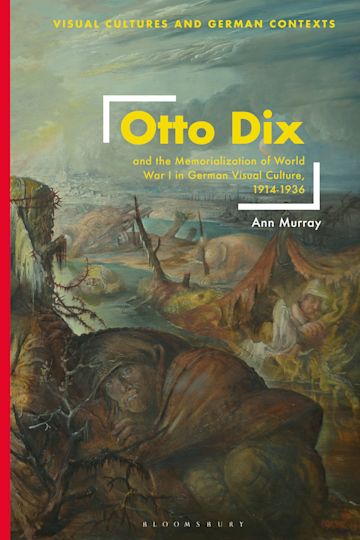
I am delighted to announce my forthcoming book, Otto Dix and the Memorialization of World War I in German Visual Culture, 1914-1936, which will be published by Bloomsbury Academic on 30.11.2023.
This peer-reviewed essay was invited as part of a special issue of Arts, A Ten-Year Journey of Arts, edited by Prof. Michelle Facos, Department of Art History, Indiana University.
This is the first essay-length study of this monumental Spanish painting in English, which memorializes the execution of the liberal General José María de Torrijos and his Companions on the beaches at Málaga in 1831, after a failed attempt to stir a revolution to topple the despotic Ferdinand VII. The painting is considered to be the greatest work by Antonio Gisbert Pérez, an artist who has received renewed attention since the painting’s permanent reinstallation in the Prado, Madrid, in 2007. A pivotal example of the Spanish visual culture of war, and remarkable for its innovative composition and sensitive portrayal of Torrijos and his men, the painting also depicts the Byronic, Northern Irish-born Robert Boyd, active in the final years (1830–1831) of the Greek War of Independence and who was inspired by Torrijos’ cause. This essay introduces new material that builds on existing Spanish-led research, offering a detailed analysis of the painting’s content and composition within its historical context. Read the essay on the Arts website.
It was a pleasure to take part in this wonderfully insightful event to launch this great volume, edited by Prof. Sally Charnow at Hofstra University, New York.

This short peer-reviewed article looks at this extreme right-wing art group’s actions against Otto Dix from 1927. The term ‘Degenerate Art’ is well known, especially with regard to the infamous exhibition that took place in Munich in 1937. However, one of the earliest Degenerate Art shows took place place in Dresden in September 1933. Dresden had a number of volkisch art groups, active from the early Weimar years, which were affiliated with the NSDAP and which targeted art that they considered ‘un-German’. The German Art Society was well connected to NSDAP from the early 1920s and was instrumental in the assured destruction of Dix’s career once the NSDAP took power in January 1933. The article can be read here.

I’m delighted to see my Adobe InDesign skills in print! This lovely booklet about those commemorated on the World War I memorial at St Peter’s, North Main St., Cork, written by Cork war historian Gerry White, sponsored by Cork City Council and designed and laid out by yours truly, is now on sale at St Peter’s. The memorial is undergoing restoration and will be unveiled in the near future.

