I will be presenting new research at the conference, Taboo in Cultural Heritage, Reinwardt Academie, Amsterdam, 1-2 February 2024, organised by the Open University of the Netherlands; Reinwardt Academie, University of the Arts; and the University of Amsterdam. Link to event website
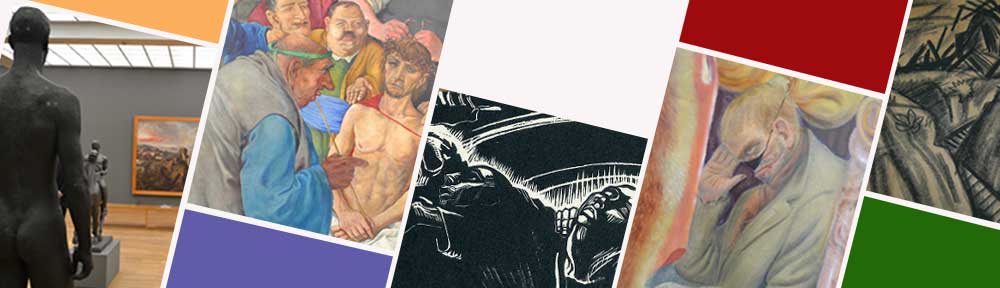
This paper (re)considers the contested influence of Dresden Academy of Arts professor and NSDAP member Richard Müller (1874-1954) on Otto Dix (1891-1969), an artist considered ‘degenerate’ and banned from exhibiting by the Nazis in 1933, and pilloried by Müller in a newspaper article that year. Unsurprisingly, perhaps, references to Müller’s influence on Dix and other artists of his generation is played down if not absent in Dix scholarship. Yet, published material from the Weimar years remarks on the impact of Müller’s highly academic style on Dix, who was a student and then professor at the Academy. This paper examines works by both artists to show how readdress to Müller’s influence complicates analysis of Dix’s work, including his famous triptych War, which betrays engagement with motifs in Müller’s painting and graphic work of the early post-World War I years.
 Dr Ann Murray
Dear Ms. Murray,
I find the topic of your presentation on the influence of Richard Müller on Otto Dix very interesting. I would be delighted if there was a possibility of obtaining the manuscript of your lecture after the presentation on 01.02.2024.
I have been studying the art of New Objectivity for many years, and in particular the art of Richard Müller.
Richard Müller’s painting style was highly academic on the one hand, but also very visionary on the other. Stylistically, he was the main pioneer of New Objectivity and was also the teacher of most of the later representatives of New Objectivity. Furthermore, Richard Müller anticipated important elements of Surrealism and Photorealism in his works for many years.
His relationship with the Nazis was very ambivalent. On the one hand, he was a member of the NSDAP from 1933 to 1935 and wrote the newspaper article you mentioned. On the other hand, he was dismissed as rector of the Dresden Academy of Art in 1935 on the reason that his “skills were largely used to destroy values instead of building them up”. He was also expelled from the NSDAP in 1935. Many of his major works were banned in Germany during the Nazi time.
Unfortunately, up to now there have been very few scientific studies of Richard Müller’s art and the influence of his art on other artists.
Sincerely yours
T. R [personal data removed for GDPR]
LikeLike
Dear Mr R,
Thank you very much for your message. I’m afraid I will not be able to share the conference paper, as the organizers of the conference plan to publish the papers, and so we cannot publicly share the research findings.
However, there is some interesting material on Müller available. I am guessing (because of your email server) that you are in Germany and read German, and maybe Corinna Wodarz’s book on Muller would be interesting for you: https://www.lehmanns.de/shop/kunst-musik-theater/48098707-9783897441941-symbol-und-eros
Wodarz includes a Catalogue Raisonne of his work also, and discusses some of the connections between Dix and Müller.
Also, see the catalogue for the exhibition of Neue Sachlichkeit in Dresden, which offers some insights to Müller’s influence: https://www.amazon.de/Neue-Sachlichkeit-Dresden-Birgit-Dalbajewa/dp/3942422573
Wodarz’s book is expensive. However, it might be available through interlibrary loan.
The findings that I can’t share were found through a lot of investigation of reviews of Dix’s work during the1920s. And the holder of Dix’s estate, Franz Kempe, has been helpful.
Also, Rolf Günther’s work at the Städtische Sammlungen Freital is interesting.
I can say, though, that Dix was not taught by Müller in any official capacity (Dix is not on the list of students for Müller at the Dresden Academy, nor in the list provider by Herr Kempe), though he may have had some indirect access to Müller drawing classes. And there are contradictions in accounts by Fritz Löffler, Dix’s biographer, as to whether Muller was involved in the 1933 Degenerate Art exhibition in Dresden.
I hope this might be helpful,
Very best wishes,
Ann
LikeLike